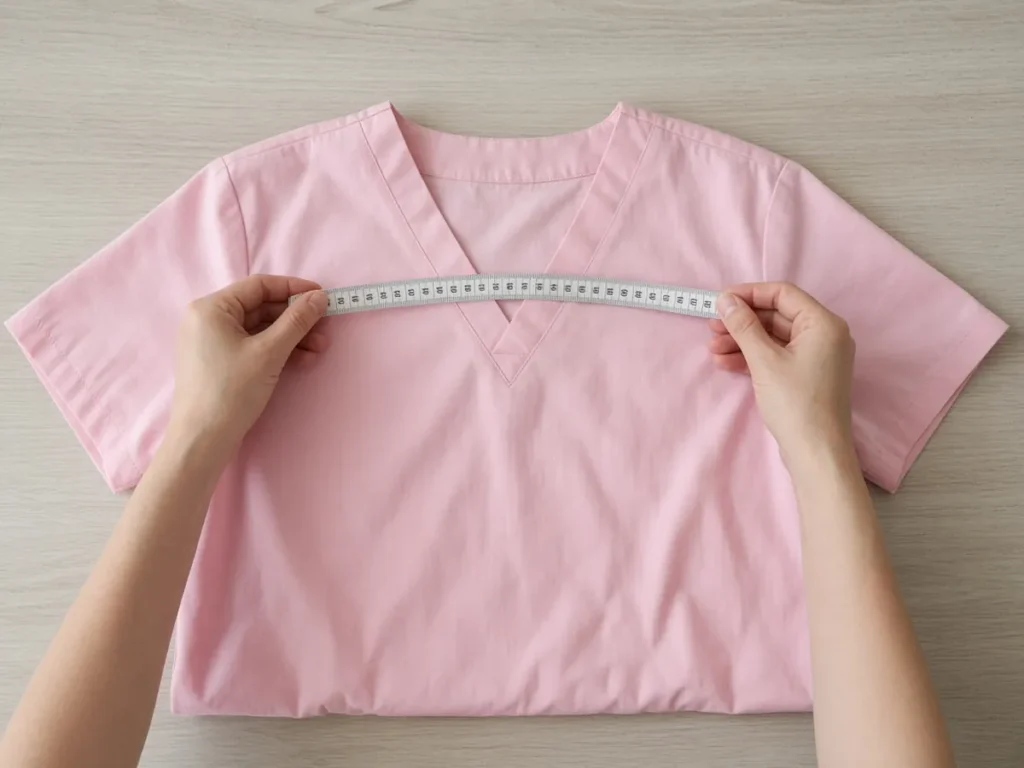
A scrubs tech pack is the set of documents a factory uses to quote, sample and produce your scrub design. It holds flat sketches, a bill of materials for fabric and trims, a measurement spec with grading, construction notes, color and logo positions, label details and packing instructions. When you develop your own style, the quote, the first sample and every reorder are checked against it.
Scrubs need more detail than a generic fashion template gives. The factory has to know where each pocket sits, how the waistband is built and how every measurement changes across a wide size range. If you buy existing styles under your own label, you need far less.
What a scrubs tech pack is, and when you need one
The tech pack matters most on the OEM route, where the factory builds a garment that does not exist yet. On the private label route, the factory already owns a tested pattern and fabric. See OEM vs private label scrubs for the wider trade-offs.
| Situation | What the factory needs from you | Who writes the measurement spec |
|---|---|---|
| Private label (existing style) | Style number, colors, size mix, logo positions, labels, packing | The factory |
| Modified existing style | The base style plus marked-up sketches of each change | The factory updates it; you approve the changed points |
| OEM (new design) | A full tech pack, or a sketch or reference garment turned into one | You, your designer or the factory, agreed before sampling |
Flat sketches and the details scrubs depend on
Flats are front and back line drawings of the garment laid flat, in proportion and without a model. Add close-ups for pockets and waistbands, and label each callout so it matches a line in the bill of materials or the measurement spec.
- Neckline type (V-neck, mock wrap, mandarin collar) and edge finish.
- A pocket map: chest, lower patch, pen slots, phone pocket, badge loop and utility loops, each with size and position.
- Side vents with their length, plus any yokes or princess seams.
- Sleeve hem, or rib cuffs on long sleeves.
- Waistband: drawcord with elastic back, full elastic or knit yoga band, and the drawcord exit.
- Leg shape (straight, jogger with rib cuff, flare) and cargo pockets.
- Petite or tall inseams, if they are separate SKUs.
Fabric and trims: the bill of materials
The bill of materials lists every physical component. Anything left off it is chosen by the factory, which may not match what you intended. Our guide to scrub fabric blends helps you choose the fabric first.
- Fiber content by percentage with generic fiber names (for example “rayon made from bamboo”, never “bamboo fabric”).
- Woven or knit, weight in GSM with an accepted tolerance (see our scrub fabric weight guide), and stretch type and direction.
- Color reference and the approved lab dip.
- Wash tests the fabric must pass, named by method: AATCC TM135 for fabric shrinkage after home laundering, TM150 for finished garments and TM61 for accelerated colorfastness to laundering. The scrub fabric testing guide explains each one.
- Trims: thread, drawcord, elastic, rib knit, snaps or zippers on jackets and any interlining, each with size, color and finish.
Test results also back your care label. The FTC Care Labeling Rule requires reliable evidence for every care instruction you print.
Measurement spec: points of measure and grading
The measurement spec lists each point of measure (POM), says exactly how it is taken and gives a base-size value, a grade rule for each size step and a tolerance. State the unit at the top and measure the finished garment flat unless a point says otherwise.
| Garment | Point of measure | How it is measured | Notes for the spec |
|---|---|---|---|
| Top | Body length | High point of shoulder to hem | State the tolerance; check petite and tall variants if offered |
| Top | Chest width | Straight across, a stated distance below the armhole | Main fit point; fit-check the base and largest size |
| Top | Bottom sweep | Across the hem | Measure with vents closed |
| Top | Shoulder and sleeve length | Seam to seam; shoulder point to sleeve hem | Separate tolerance for each |
| Top | Neck width and V-neck drop | Across the opening; shoulder line to point of the V | Small dimension, so a tighter tolerance than chest |
| Top | Pocket and vent positions | From high shoulder point and center front, or from hem | Tight tolerance; misplacement is visible |
| Pant | Waist relaxed and extended | Across the waistband at rest and fully stretched | Give both values, each with its own tolerance |
| Pant | Hip and thigh | Below the waistband; just below the crotch | State the measuring distance in the spec |
| Pant | Front and back rise | Crotch seam to top of waistband | Tight tolerance; affects comfort |
| Pant | Inseam | Crotch seam to hem | One value per length variant |
| Pant | Leg opening or cuff | Across the hem | Joggers: cuff height and relaxed opening |
Base size, grading and tolerances
Choose a base size near the middle of your range that you can fit on a real person, and grade outward from it. A run from XS to 5XL spans very different proportions, so one fixed step per size rarely fits both ends. Ask where the grade steps change and fit-check a larger size too. Keep this production spec separate from the body chart customers see, such as a public scrub size chart.
There is no universal tolerance for scrubs. Set one for each point and write it beside the measurement, as in the notes above.
Construction, stitching and reinforcement
Name stitch and seam types by a recognized classification rather than words like “strong seam”. ASTM D6193, Standard Practice for Stitches and Seams, is a common US reference that groups them by category, formation and general purpose.
- Seam type and finish for side, shoulder, inseam and crotch seams.
- Stitch type and agreed stitch density for each operation.
- Hem finish for top, sleeves and pant legs.
- Bar tacks at pocket corners, cargo pockets, loops and the drawcord exit.
- How the waistband elastic is attached and the drawcord secured.
- Topstitch color and distance from the edge.
Colors, logos and label placement
Give each color a Pantone TCX reference, Pantone’s cotton swatch standard for apparel, and send a physical swatch too. List each colorway with the fabric, thread, drawcord and rib it uses, and approve a lab dip for each before sampling.
For logos, include the artwork file, finished size, method, thread or ink colors and a position measured from the high shoulder point and center front. See our pages on custom embroidery for scrubs and where to place a logo on scrubs.
The label page shows each label, its content and where it is sewn. Under FTC textile rules, labels must show fiber content, country of origin and the manufacturer or dealer identity, and on garments with a neck the country of origin goes on the front of a label at the inside center of the neck. The FTC labeling guide has the details, and our article on scrub label requirements applies them to scrubs.
Packing instructions
Write packing into the tech pack so the first carton matches what your warehouse or retailer expects.
- Fold method and folded size for tops and pants.
- Sets packed together or as separate pieces.
- Polybag type, hang tag position and barcode or SKU sticker position.
- Carton assortment (single size, single color or mixed) and carton markings.
Keeping the tech pack current through sampling
A tech pack changes with every sample round. If comments stay in chat and email, bulk follows an older version.
- Put a version number and date on every page and keep a revision log.
- Record each sample’s measurements against the spec, with the difference beside each point.
- Write fit comments on the relevant page, with marked-up photos.
- Mark one version “approved for production” and tie it to the approved sample.
- Use that version for reorders and issue a new one for any change.
Working from a tech pack at GoMedWear
GoMedWear makes scrubs in its own factory in Sialkot, Pakistan. Through OEM scrub manufacturing, we build to your tech pack, sketch or reference garment. OEM minimums are quoted per project because pattern and fabric development differ by design. Patterns are computer-graded, sizes run from XS to 5XL depending on the style, and you can pick from 30+ stock colors or a Pantone match.
Every order starts with a sample, and bulk production takes 15 to 25 days after you approve it. We use lab dips, sealed samples, inline checks, a full audit before packing and AQL inspection, and keep patterns and color runs on file so reorders match. Embroidery, printing, woven labels, care labels and hang tags are done in-house.
If you would rather start from a developed style, private label scrubs start at 50 pieces per style with colors and sizes mixed. Review our custom scrub options or request a free size-set sample before you finalize your spec.
Frequently asked questions
Who should own the tech pack?
Settle this in writing before sampling starts. Ask any supplier who prepares the measurement spec and construction pages, who keeps the approved version that bulk and reorders are checked against, and whether you receive the graded measurement spec and pattern files at the end of development. The answers decide how easily you can add a second factory or move production later, so put them in the quote or development agreement.
Can a factory work from a sample garment instead of a tech pack?
Yes, many OEM projects start from a reference garment or a sketch. The factory measures the garment and develops a pattern and spec from it. Before sampling, agree in writing which details must be copied exactly, what changes, which fabric replaces the original and who keeps the resulting spec. Without that, the sample may copy faults in the reference along with the parts you liked.
Which size should be the base size in a scrubs tech pack?
Pick a size near the middle of your range that you can fit on a real person, often the size most of your customers wear. All other sizes are graded from it, so the base size gets the most fitting attention. With a range that reaches 4XL or 5XL, also fit-check a larger size, since grade steps that work near the base can fail at the ends of the range.
How much should a tech pack cost?
Cost depends on who prepares it, how many styles and colorways it covers and how complex the garment is. A scrub top with several pockets and vents takes more pages and more measurements than a basic V-neck. Ask any designer or factory for a fixed scope: which pages are included, how many revision rounds are covered and whether grading across your full size range is part of the work.