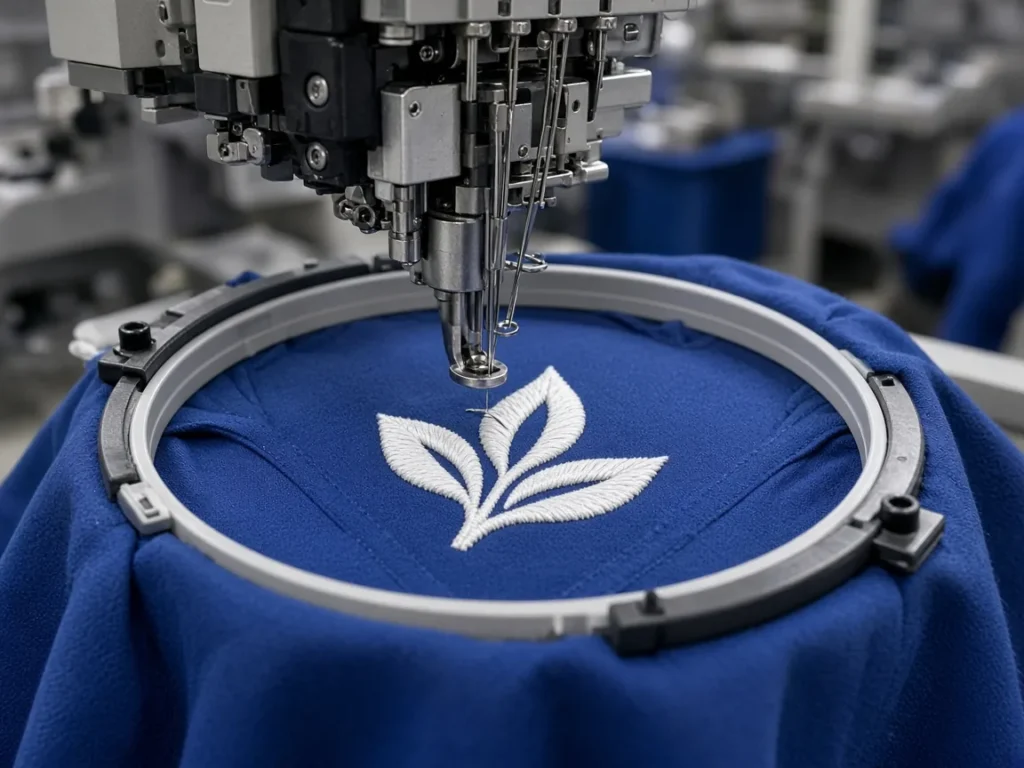
The main logo usually goes on the left chest of a scrub top, and left means the wearer’s left. The wearer’s name goes on the right chest or on a line under the logo. Sleeves carry secondary marks such as a department or program badge, and the back yoke is kept for larger team graphics. No regulation or industry standard fixes these positions, so the right placement is the one your team agrees on and locks in on the approved sample.
For a buyer ordering 50 or more pieces per style, picking a side is the easy part. The harder questions are how a chest pocket or a deep V-neck moves the logo, how one logo looks on an XS and on a 5XL, where a scrub brand puts its own mark, and how to write it all down so the reorder matches.
Where logos and names usually go
The left chest is the usual default for scrub logos and the position decorators typically suggest, and it is the safe choice when your policy says nothing. The right chest is the usual home for a name, so logo and name sit balanced on either side of the placket or neckline.
Decorators publish left-chest measurements that disagree by several inches, so treat any number you read as one supplier’s habit. Before you choose, check two things:
- Your uniform or dress code policy. Some hospitals and schools already state where the logo and name go, and a new order should follow it.
- Where staff wear ID badges. If badges clip to the chest or hang from a pocket, keep the logo clear of that spot so it is not covered all shift.
Placement zones on scrub tops and pants
Each zone suits a different job. Here is what each one is used for and what tends to go wrong.
| Zone | Typical use | Watch-outs |
|---|---|---|
| Left chest | Main clinic, hospital or school logo | Deep V-necks and wrap fronts leave less flat fabric; badge clips can cover it |
| Right chest | Wearer’s name, title or a second logo | Must line up with the left-chest logo at the same height, or the top looks uneven |
| On or above the chest pocket | Small logo or name on tops with a patch pocket | Pens and phones pull the pocket and hide the design |
| Upper sleeve | Department, unit, program year or a brand mark | Narrow area on short sleeves; raglan and dolman sleeves have seams in odd places |
| Back yoke | Team name, event or large program graphic | Adds a decoration step and cost; a large dense design stiffens the fabric |
| Pant hip or upper thigh | Small brand mark or matching program logo | Sits near cargo and side pockets; stretch fabric can pucker under dense stitching |
Logo and name together: layouts that work
Choose one of three layouts and use it on every top in the program.
Split layout
Logo on the left chest, name on the right chest, both at the same height. This is a common choice and the easiest to read across a room.
Stacked layout
Logo on the left chest with the name on a line directly beneath it. It keeps the right side free for a badge and works well on tops with one chest pocket on the right.
Sleeve and chest
Logo on the upper sleeve and name on the left chest. It suits programs where the employer logo matters less than a clear name, or where a scrub brand wants the chest kept clean.
Whichever you pick, check these points before approving:
- The name text is never wider than the logo in a stacked layout.
- Thread color reads clearly on every fabric color in the order. If you run color-coded scrubs by role, test the thread on each shade, and see the stock scrub color range for thread and fabric pairings.
- The method suits the design. Very small text and fine detail can be hard to stitch cleanly, and the comparison of embroidery, screen printing and DTG covers the trade-offs.
What goes on the name line
Agree on one format for the whole team before anyone sends a name. Decide whether it is first name only or full name, whether credentials follow the name, whether a role such as “Dental Assistant” gets its own line, and which letter case and font everyone gets. Credential order has its own conventions, covered in our guide to credential order and lab coat embroidery etiquette.
Titles can be regulated. In California, Business and Professions Code section 680 requires health care practitioners to show their name and license status on a name tag in at least 18-point type while working, with some exceptions, and limits who may use the title “nurse”. That is one state’s example and not legal advice. Check your own state and facility policy, and do not assume an embroidered name replaces a required name tag.
For a group order of named nurse uniforms or other team scrubs, send names as a spreadsheet with one row per garment: name exactly as it should be stitched, credentials, garment style, color, size and quantity. Have each person check their own spelling before you submit it, and confirm with your supplier that name-by-name embroidery is included and which list format they need.
How style details and sizes change placement
The same position can look different on each style, so review them one by one:
- V-necks: a deep V pulls the flat chest area toward the shoulder, so the logo may need to sit higher or closer to the armhole.
- Mock wraps and overlaps: the overlap edge can cut through a left-chest logo. Keep the design fully on one layer of fabric.
- Zips and snaps: on scrub jackets and zip tops, leave space between the logo and the closure so the zip tape does not distort the stitching.
- Chest pockets, pen slots and badge loops: plan the logo around them, not across them. Ask any supplier whether logos are stitched on cut panels before sewing or on finished garments, because it affects what can go on a pocket.
Size range matters too. A logo that fills the chest of an XS can look small on a 5XL, and a logo sized for a 5XL can reach the armhole on an XS. Use one logo size for the whole range or two size tiers, and approve the smallest and largest sizes on the sample, not just a medium.
Clinic logos vs scrub brand marks
A clinic wants its logo on the chest, where patients see it. A scrub brand selling to clinics, schools or distributors should leave the chest free for that customer’s logo and carry its own identity elsewhere:
- A woven label inside the back neck
- A small woven tab on the sleeve or at the hem
- A small embroidered mark on the sleeve or pant hip
- Care labels and hang tags with the brand name
If you are building a range under your own name, private label scrub manufacturing covers how labels and branding are added. Use only logos you own or are authorized to use, and keep written permission on file for any client logo you decorate.
Put placement in the spec and approve it on the sample
Placement drifts when it lives only in an email thread. Write it into the spec and confirm it on a physical sample. Record:
- The zone and side for each design, stated from the wearer’s view.
- The reference point and distance, for example measured from the shoulder seam and from the center front, with the same reference used on every style.
- The finished logo size for each size tier.
- Thread or ink colors for each fabric color.
- The decoration method and the approved artwork file.
- The name-line format and the name list version.
Photograph the approved sample with a ruler in frame and keep it with the order. If you send a full scrub tech pack, add the placement page to it. Get this right before bulk: removing embroidery can leave holes or marks in the fabric, so a misplaced logo is hard to fix after production.
Logo placement at GoMedWear
GoMedWear makes scrubs in its own factory in Sialkot, Pakistan, and does embroidery, DTG printing, screen printing, sublimation, woven labels, care labels and hang tags in-house. Every order starts with a sample, so ask for your logo, name line and thread colors to be shown on it and confirm placement before bulk. See our custom embroidery service and custom printing options, while custom scrubs with logo covers building a style to your spec.
Private label orders start at 50 pieces per style, with colors and sizes mixed within those 50. Bulk production takes 15 to 25 days after sample approval. Sealed samples are part of quality control, and patterns and color runs are kept on file so reorders match. To check placement on your own logo, request a free size-set sample.
Frequently asked questions
Which side of scrubs should the logo go on?
The main logo usually goes on the wearer’s left chest, and the name on the right chest or under the logo. No standard requires this, so follow your uniform policy if it names a side. Keep the logo clear of where staff clip ID badges, and confirm the exact position on the approved sample so every size and every reorder matches.
Should a name be embroidered on the left or right?
If the logo is on the left chest, the name usually goes on the right chest at the same height, or on a line directly below the logo. Pick one layout for the whole team and use it on every top. Agree the name format, credentials and letter case first, and collect names in a spreadsheet so each person can check their spelling.
Can embroidery be removed from scrubs?
Embroidery can be unpicked, but removal can leave needle holes, marks or a shiny patch where the stitching sat, especially on tightly woven or stretch fabric. A garment with a removed logo rarely looks new. For that reason, check placement, size, spelling and thread color on the sample before bulk production, and order spare stock for staff turnover.
Can scrubs have a logo on the sleeve or back?
Yes. The upper sleeve suits a department, unit or program mark, or a scrub brand’s own mark, and the back yoke suits a larger team graphic. Each extra location adds a decoration step, so limit it to what the program needs. Check sleeve style first, because short and raglan sleeves leave less flat area for stitching.