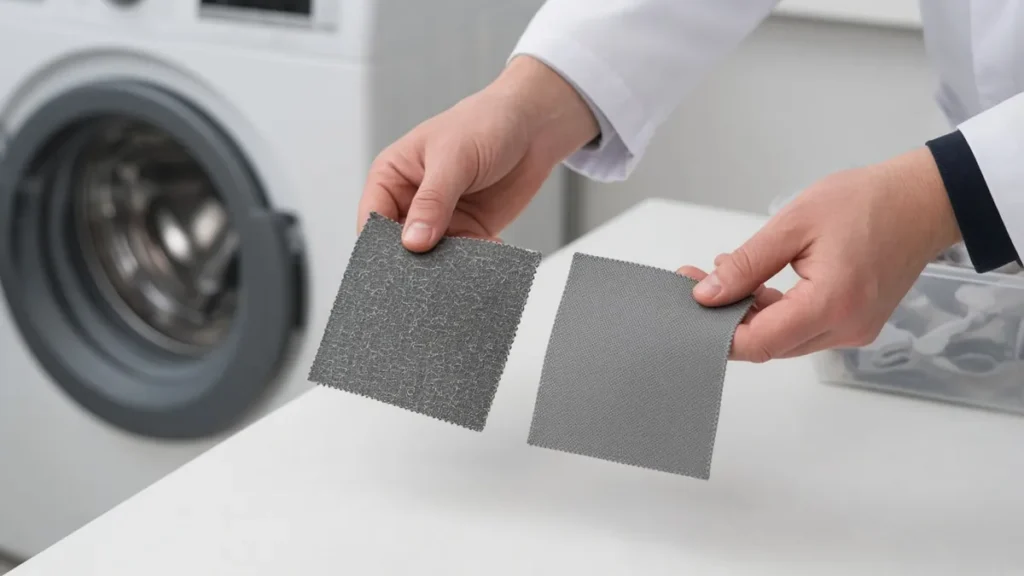
Scrub fabric testing means checking, before the bulk order is cut, how a fabric behaves after washing and wear. The main questions are how much it shrinks, whether it pills, whether the color holds up to laundering, bleach and rubbing, and whether the seams and stretch survive. For a brand, distributor or hospital program, those results decide whether the garments still fit and match after months of use.
The short version: ask for dimensional change, pilling, colorfastness and seam tests to named methods, agree the tolerances in writing before cutting, and make sure the results come from the fabric lot your order will be cut from. This guide lists the methods to put in a spec, explains how to read a test report, and ends with a checklist to run before you approve production.
Why scrub fabric testing comes before the bulk order
Scrubs go through the wash often, and many are washed hot, dried hot or sent to an industrial laundry. A fabric that looks right on a swatch card can shrink out of its size, fade unevenly against the rest of a team’s sets, or pill at the thighs within weeks.
A problem found on a few meters of fabric costs a test and a short delay. The same problem found after cutting means remaking the order or living with complaints. Testing early also gives you something precise to write into your agreement with the factory instead of “good quality”.
The tests that matter for scrubs
You do not need every textile test in the catalog. The table below covers the properties that cause most scrub complaints and the method names to put in your specification.
| Property | Why it matters on scrubs | Methods to name |
|---|---|---|
| Dimensional change (shrinkage) | Tops ride up and pants lose length after the first washes | AATCC TM135 (fabric) or AATCC TM150 (garments) for home laundering; ISO 5077 with ISO 6330 (domestic) or ISO 15797 (industrial) wash procedures |
| Appearance after laundering | Puckered seams and surface changes make a set look old | AATCC TM143 |
| Pilling | Rubbing at thighs, underarms and seat | ASTM D3512 (random tumble), ASTM D4970 (Martindale) |
| Colorfastness to laundering | Fading after repeated washes, plus an indication of staining onto other fabrics | AATCC TM61 |
| Colorfastness to bleach | Facilities and detergents that use chlorine or oxygen bleach | AATCC TM188 (chlorine), AATCC TM172 (non-chlorine) |
| Colorfastness to rubbing | Dark shades transferring onto chairs, bags and lighter garments | AATCC TM8 |
| Colorfastness to perspiration and light | Long shifts and garments dried or worn in sunlight | AATCC TM15, AATCC TM16.3 |
| Seam failure | Split crotch and side seams, slippage at stress points | ASTM D1683 (woven fabrics) |
| Stretch and recovery | Bagging at the knees and seat on stretch blends | ASTM D3107 (wovens with stretch yarns) |
For background on how each blend tends to behave, see our comparison of scrub fabric blends. Weight is a separate question, covered in the guide to scrub fabric GSM.
Shrinkage after home and industrial laundering
AATCC TM135 measures dimensional change of fabric after home laundering, and AATCC TM150 does the same for finished garments. Testing the garment is useful because seams, facings and waistbands can move differently from flat fabric.
The wash procedure should match how your scrubs will really be cleaned. ISO 6330:2021 sets domestic washing and drying procedures for textile testing, and ISO 15797:2017 sets industrial washing and finishing procedures for testing workwear. Neither ISO procedure measures shrinkage on its own: the change in size is measured to ISO 5077, after washing to ISO 6330 or ISO 15797. Because ISO 15797 is a lab simulation, ISO notes for ISO 15797 that testing in the actual laundering process can be advisable to confirm a garment and a process work together.
Fiber matters too. 100% cotton scrubs generally need closer attention to shrinkage than polyester medical scrubs, and finishing at the mill changes the result for any blend. Agree a tolerance for length and width with your supplier before cutting, and confirm whether the patterns already allow for it.
Pilling and surface wear
Two common pilling methods are ASTM D3512, which tumbles specimens in a random tumble tester, and ASTM D4970, which uses a Martindale tester. Results are graded on a scale from 5 (no pilling) to 1 (very severe pilling).
Treat the grade with care. ASTM states that D3512 is not recommended for acceptance testing because between-laboratory precision is poor, and it advises caution with D4970 because interlaboratory data are not available. The practical approach is to compare candidate fabrics in the same lab, then confirm the winner with a wash-and-wear trial of the sample, paying attention to inner thighs, underarms and the seat.
Colorfastness: washing, bleach, rubbing and light
AATCC TM61 is an accelerated laundering test. AATCC says one 45-minute test roughly approximates the color loss of five typical home launderings, so it gives an early read on fading without waiting for months of wear.
Add the tests that match your users. AATCC TM188 covers sodium hypochlorite (chlorine) bleach in home laundering, and TM172 covers powdered non-chlorine bleach. AATCC TM8 checks crocking, the transfer of color by rubbing, which matters most on navy, black and other deep shades. TM15 covers perspiration and TM16.3 covers light, using a xenon-arc lamp.
Test each shade you plan to order. A pass on ceil blue says nothing about wine or black, because dyes and dye depth differ. If your range includes very dark or bright colors, the guide to scrub color options helps you plan which shades need the closest checks.
Seams and stretch recovery after washing
ASTM D1683 measures failure in sewn seams of woven fabrics, either by rupture or by yarn slippage. ASTM notes that it does not predict actual wear performance, so use it to compare seam and stitch choices and to catch fabrics that slip at the seam. Then check the crotch, side seams and pocket corners on a washed sample.
For stretch blends, ask for stretch and recovery to be measured after laundering as well as before, since growth at the knee and seat shows up over time. The guide to 2-way and 4-way stretch explains how to specify stretch by direction.
How to read a fabric test report
A report is only useful if it describes the fabric you are buying, tested the way you asked. Check these points before you accept one:
- Method and edition. The method should be named with its edition or year, for example ISO 6330:2021. An old or withdrawn edition is a reason to ask questions.
- Sample identity. The sample ID, color and fabric lot or roll number should match the fabric your order will use. A mill’s general report on the base cloth does not cover your shade.
- Lab and date. Note who ran the test and when. A report from several seasons ago may describe a different production run.
- Conditions. Wash temperature, number of cycles, drying method and bleach type should match your laundering route.
- Results against your tolerance. A report that says “pass” without stating whose requirement it passed tells you little. Compare each result with the tolerance you agreed.
A pre-bulk testing checklist
- Decide the laundering route for each user group (home, facility or industrial laundry) and pick the matching wash procedure.
- List the test methods and editions in your scrub tech pack or fabric specification.
- Agree a written tolerance for each property before any fabric is cut.
- Test every shade in the order, starting with the darkest and brightest.
- Confirm which fabric lot the bulk will be cut from, and test that lot or confirm it matches the tested one.
- Wash and wear the size-set sample on real shifts and note shrinkage, pilling and fading.
- Keep the results with the sealed sample so they become the standard for reorders.
- Repeat the key tests whenever a reorder uses a new fabric lot.
When you are comparing factories, the checklist for vetting a scrub manufacturer covers the questions to ask about their process.
How fabric is checked at GoMedWear
GoMedWear makes scrubs in its own factory in Sialkot, Pakistan, and every order starts with a sample. Free size-set samples are offered, lab dips are used to approve color, and the approved sample is sealed as the reference. During production there are inline checks at the machine, a full audit before packing and AQL inspection. Patterns and color runs are kept on file so reorders match, and the steps are described on our quality control page.
For private label scrubs, the minimum is 50 pieces per style, with colors and sizes mixed. For OEM orders built to your tech pack, minimums are quoted per project. Bulk production takes 15 to 25 days after you approve the sample. If your program needs lab results to named methods, list the methods and tolerances in your brief and ask how testing will be arranged before sampling, then request a free size-set sample to start wash-testing.
Frequently asked questions
Do scrubs shrink after washing?
Most scrub fabrics move a little in the first washes, and how much depends on fiber, construction, finishing and the wash and dry settings. Cotton-rich fabrics usually need closer watching than polyester-rich ones. Rather than relying on a general figure, have the fabric tested to AATCC TM135 or the garment to AATCC TM150 for home laundering, or to ISO 5077 after ISO 15797 washes for industrial laundering. Agree the tolerance in length and width before cutting.
What is the best test for pilling on scrub fabric?
Two common methods are ASTM D3512, which uses a random tumble tester, and ASTM D4970, which uses a Martindale tester. Both grade the fabric on a scale from 5 (no pilling) to 1 (very severe pilling). ASTM cautions against relying on either for acceptance testing, so compare candidate fabrics in the same lab and back the grade with a wash-and-wear trial of the sample.
Which test shows whether scrubs will fade?
Start with AATCC TM61, the accelerated laundering test. AATCC says one 45-minute test roughly approximates the color loss of five typical home launderings. Add AATCC TM188 if the garments may meet chlorine bleach, TM172 for non-chlorine bleach and TM8 for rubbing on dark shades. Test each shade you plan to order, because results for one color do not carry over to another.
Should we test the sample fabric or the bulk fabric?
Both, if you can. Sample yardage shows whether a fabric is suitable, but the bulk order is cut from a production lot that can behave differently. Ask the supplier which lot the bulk will come from, have the key tests run on that lot or confirm it matches the tested one, and record the lot reference with the sealed sample so reorders are checked against the same standard.