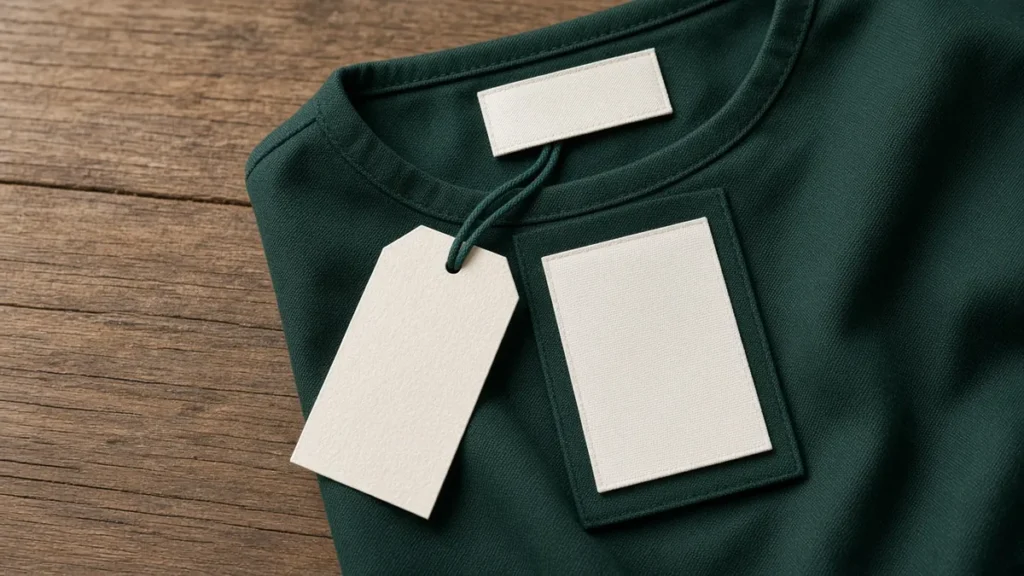
Under US clothing label requirements, scrubs need four disclosures. The Textile Fiber Products Identification Act requires fiber content, country of origin and the name or RN of a business that makes, imports, distributes or sells the garment. The FTC Care Labeling Rule adds care instructions.
On a private label or OEM line made overseas, the US brand or importer answers for the wording, while the factory sews the labels in. Approve every label before bulk production. This is general guidance, not legal advice; confirm details with the FTC rules or a licensed customs broker.
US clothing label requirements: the four things a scrub label must show
These rules cover scrub tops, pants, jackets and lab coats. The FTC guide to the Textile and Wool Acts has the detail.
| Disclosure | Rule | Example wording | Where it goes |
|---|---|---|---|
| Fiber content | Textile Act | 65% Polyester, 35% Cotton | Any conspicuous label, inside or outside |
| Country of origin | Textile Act, checked by CBP at entry | Made in Pakistan | Front of the label at the inside center neck; a conspicuous label on pants |
| Business identity | Textile Act | Your company name, or RN plus your number | Same label as fiber content, or another accessible label |
| Care instructions | FTC Care Labeling Rule | Machine wash warm. Only non-chlorine bleach, when needed. Tumble dry low. | Permanent label, easy to find at the point of sale |
Scrub caps are the exception. The FTC leaves headwear worn only on the head out of the Textile Act’s labeling rules, and the Care Labeling Rule excludes hats. Imported caps generally still need a country-of-origin marking for customs.
Fiber content for scrub blends
List fibers by generic name and percentage of fiber weight, largest first, such as “62% Polyester, 35% Rayon, 3% Spandex”, or “100% Cotton” for a single fiber. The FTC allows a 3% tolerance, except on single-fiber labels. Take the figures from the mill specification. If you are still choosing a fabric, compare scrub fabric blends first.
- Spandex under 5%. Fibers below 5% are usually grouped as “other fiber”, but spandex can be named because stretch is a functional purpose.
- Rayon or viscose. Both names are accepted. Use one consistently.
- Linings for warmth. A lining that adds warmth, as in fleece-lined pants, must be listed separately. A purely structural lining need not be.
- Branded fibers. A fiber trademark must sit next to its generic name, equally conspicuous and in the same type size.
Rayon made from bamboo
The FTC says most, if not all, “bamboo” textiles are actually rayon. Label them “rayon made from bamboo” (viscose may replace rayon). Only fiber made directly from bamboo by mechanical processing can be called bamboo. In 2022 Kohl’s and Walmart agreed to pay FTC civil penalties over rayon products marketed as bamboo.
Country of origin and neck-label placement
On garments with a neck, the origin goes on the front of a label at the inside center of the neck, midway between the shoulder seams or next to another neck label. Fiber content and identity can share it, sit on its back if it is sewn at one end only, or go on another accessible label. Pants need a conspicuous label, such as one inside the waistband.
Write it in English, usually as “Made in Pakistan”. For cut-and-sewn garments, origin generally follows where the garment is wholly assembled, not where the fabric was made. Some tariff headings have exceptions, so confirm with your broker. Online listings must also state that the scrubs are imported.
Labels must be on at customs
CBP requires imported textile products to carry Textile Act labels at importation (19 CFR 11.12b). If goods arrive unlabeled, the importer may have to relabel them under customs supervision at its own expense, and goods not brought into compliance can lead to liquidated damages. Sewing every label at the factory avoids this. For duties and paperwork, see our guide to importing scrubs from Pakistan to the USA.
Whose name or RN goes on a private label garment
The identity must be the full name your company uses in business, or its FTC registered identification number (RN). A brand, trademark or designer name does not count unless it is also the business name. If your brand differs from your company name, print the company name or RN beside it.
RNs are free, applied for online and issued only to US-based businesses that make, import, distribute or sell textiles. A factory abroad cannot hold one. Imported goods may name the foreign maker or distributor, or carry the name or RN of the US importer, wholesaler or a consenting retailer. For private label scrubs, that usually means your own RN or business name.
- Update your RN record if your business name, address or legal status changes, or the FTC can cancel it.
- A business that replaces a label must keep records for three years showing the original label’s details and who supplied the goods.
If you are starting a scrub brand, apply for the RN as soon as the company is registered.
Care labels, and when hospital uniforms are exempt
Manufacturers and importers must attach a permanent care label that is easy to find at the point of sale and stays legible for the garment’s useful life. A washing instruction covers the method, a water temperature if regular use of hot water would harm the garment, bleach, drying, ironing where needed, and warnings. ASTM D5489-96c symbols may replace words (see the FTC’s care labeling guide).
Every instruction needs a reasonable basis. For a garment with several components, that means evidence the whole garment survives the care. Write scrub care labels from wash tests on the approved sample, logos and trims included.
The institutional-buyer exemption
Care instructions are not required on products sold to institutional buyers for commercial use (16 CFR 423.8(e)). The FTC explains this as uniforms employers buy for staff to wear at work, and names hospitals and nursing homes among those buyers. A hospital uniform program in which the employer buys the scrubs, rather than staff buying their own, can skip care labels, within limits:
- It does not apply when employees buy their own scrubs.
- It covers care instructions only. Fiber content, origin and identity labels still apply.
- Units sold to the public need care labels, so one specification for every unit is often simpler.
Hang tags and claims that need proof
Hang tags are optional, but every claim on them, stated or implied, must be truthful and backed by evidence.
- Fiber callouts. A tag that names a fiber without the full content must say so, for example “See label for the product’s full fiber content”, near the fiber name and in type at least as large.
- Performance and green claims. Fluid-resistant, wrinkle-free or eco-friendly claims need test reports or other competent evidence on file before printing.
- Antimicrobial wording. Under EPA’s treated-article exemption, a fabric treated with a registered antimicrobial may only claim to protect the fabric itself. Stated or implied claims about protecting people from germs fall outside it.
Kids’ scrubs follow extra CPSC rules
Scrubs and lab coats designed or intended mainly for children 12 and under are children’s products. They need third-party testing by a CPSC-accepted lab and a Children’s Product Certificate from the US importer or domestic manufacturer. They also need permanent tracking labels on the garment and its packaging, where practicable, showing the maker or private labeler, production place and date, and batch. Plan all three before sampling kids’ scrubs and lab coats.
Label approval checklist before bulk
Send this with the purchase order. For OEM styles, add it to the label section of your scrub tech pack.
- Business name or RN, matching your current FTC record
- Fiber content for each fabric from the mill specification, in weight order
- Origin wording confirmed by your customs broker
- Label positions: inside center neck on tops and coats, waistband on pants
- Care instructions and label material proven by wash tests on the sealed sample
- Hang tag claims backed by evidence on file
- Online listings that say the scrubs are imported
- For kids’ sizes: test plan, certificate issuer and tracking-label content
- A pre-production sample with real labels sewn in, signed off before cutting
How labeling works at GoMedWear
GoMedWear makes woven labels, care labels and hang tags in-house at its own factory in Sialkot, Pakistan. You supply the business name or RN and approve the final wording. Private label scrub orders start at 50 pieces per style, with colors and sizes mixed within those 50. OEM styles are built to your tech pack, sketch or reference garment.
Every order starts with a sample, and free size-set samples are offered. Bulk production takes 15 to 25 days after sample approval, with sealed samples, inline checks, a full audit before packing and AQL inspection as part of the factory’s quality control. For US buyers, orders ship DDP door-to-door with duties paid, or FOB Karachi if you use your own forwarder. To check fabric and finish before you finalize labels, request a free sample.
Frequently asked questions
Do scrubs need an RN number?
No. The label needs your full business name or an RN, so the number is optional. The FTC issues RNs free, but only to US-based businesses. Imported private label scrubs usually carry the RN or business name of the US brand or importer.
Can I put my own label on factory-made scrubs?
Yes, as long as each garment also shows fiber content, country of origin, care instructions and your business name or RN. A brand name alone does not count unless it is your business name. If you replace a label already on the goods, keep records for three years.
Do scrubs bought by a hospital need care labels?
Not when the hospital buys them for staff to wear at work. Care instructions are not required on products sold to institutional buyers for commercial use. The exemption ends when employees buy their own scrubs, and fiber content, country of origin and identity labels are still required.
How do I label bamboo scrubs?
Name the fiber as rayon or viscose, for example “rayon made from bamboo”. The FTC says most, if not all, bamboo textiles are rayon, and only fiber made directly from bamboo may be called bamboo. Softness, sustainability or performance claims on the tag need their own evidence.
Where does “Made in Pakistan” go on scrubs?
On tops, jackets and lab coats, it goes on the front of a label at the inside center of the neck, midway between the shoulder seams or next to another neck label. Pants need a conspicuous label, such as the waistband. Online listings must also say the scrubs are imported.