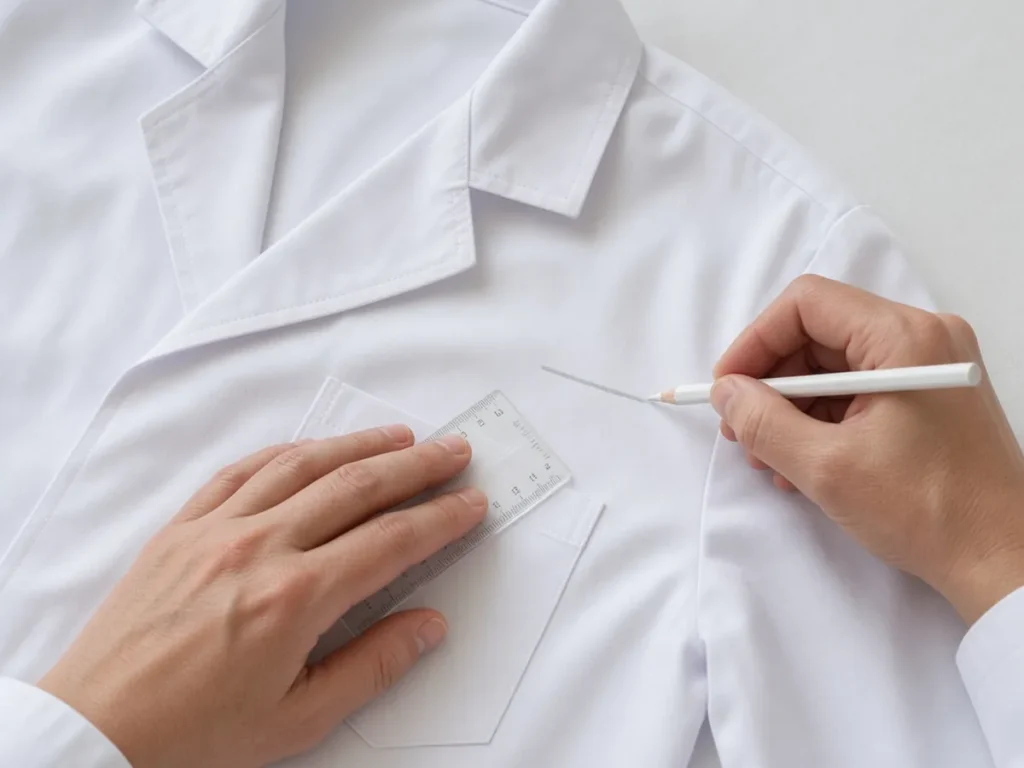
Lab coat embroidery etiquette rests on a few conventions. The name comes first with degrees after it, credentials follow a recognized order, a role or department line is optional and the logo sits on the other side of the chest. Under common editorial style the name carries “Dr.” or a degree but not both: Jane Smith, MD rather than Dr. Jane Smith, MD.
A clinic, hospital department or school ordering coats for a team should turn those conventions into a written standard: the lines that appear, one font and thread color, where each element sits and how names are checked. A wrong credential is hard to fix once stitched, so the checklists below help catch errors before production.
What goes on a lab coat: the basics of embroidery etiquette
An embroidered coat usually combines up to four elements:
- Name: first and last name, followed by degrees.
- Credentials: licensure and national certifications, on the name line or a second line.
- Role or department: for example Family Nurse Practitioner or Pediatrics.
- Logo: the practice, hospital or school emblem.
The employer or school decides which may appear, so start from the dress code and brand guide. Some health systems publish embroidery specifications, and some schools require students to use one approved vendor.
Writing the name line: titles, degrees and preferred names
Place degrees after the name, separated by commas and without periods: Jane Smith, MD or Sam Lee, PharmD. Health system style guides commonly use this form, and several university style guides drop “Dr.” when a degree follows the name. If your standard prefers “Dr.” for physicians, use it on every physician’s coat.
Who may use “Dr.” with patients is a separate question that some states regulate. Georgia requires an advanced practice registered nurse or physician assistant with a doctorate who uses the title in a clinical setting to state clearly that they are not a medical doctor. Its law also requires an identifier with name and license type or degree in some care settings, and a lab coat showing that information may count as one. Check state rules and facility policy before setting the title rule.
Then set the name rules: legal or preferred first name, middle initials, and how long or hyphenated names are shortened to fit the supplier’s line limit.
Listing credentials in the right order
For nurses, the American Nurses Credentialing Center (ANCC) gives the accepted order in its credentials policy: highest degree, licensure, national certifications, then honorary recognitions. Its guide to displaying credentials expands this to six steps:
- Highest earned degree, such as DNP, MSN or BSN
- Licensure, such as RN or LPN
- State designations or requirements, such as APRN or NP
- National certifications, such as FNP-BC
- Awards and honors, such as FAAN
- Other recognitions, including credentials from outside nursing
The same guide says one degree is usually enough, and that a nurse with a doctorate and a master’s can leave off the bachelor’s. Space on a coat is short: Jane Smith, DNP, RN, APRN, FNP-BC runs to 33 characters, so the standard should say which credentials to include or allow a second line.
ANCC’s order covers nursing only. For physicians, physician assistants, pharmacists and other roles, ask each person how they list credentials and check them against HR or credentialing records. Leave off anything that has lapsed: ANCC does not allow its credentials to be used after they expire.
Role, department and logo lines
Decide whether the role line spells out the role (Clinical Pharmacist) or names a department (Cardiology), and keep the approved wording in one list so nobody invents a variant.
Use only logo artwork the organization owns or is authorized to use, in its current version; a practice inside a health system may need brand approval first. The supplier converts the artwork into a stitch file, so approve it once and have it kept on record.
For decoration methods, see embroidery compared with printing on scrubs. If your program covers scrubs too, the guide to logo and name placement on scrubs helps keep both layouts consistent.
Placement, font and thread color
Placement conventions differ. One university medical center puts its patch on the left chest and up to three lines of text on the right, while a health system’s brand guide puts the logo on the right and the name and title above the left pocket. Either works if every coat matches.
| Element | Common choices | Decision to record |
|---|---|---|
| Organization logo or crest | Left or right chest, depending on the organization | Artwork version, finished size, thread colors, position from fixed points |
| Name and credentials | Chest, opposite the logo or above the breast pocket | Line layout and characters allowed per line |
| Role or department | A line under the name | Approved wording and abbreviations |
| Lettering | Block letters, or a script for names | Font name, case and letter height |
| Thread | One contrasting text color; logo colors from the brand guide | Thread maker and color numbers |
Lapels, collars and pockets change where text can sit, so choose the style from the medical lab coat range before fixing positions. Then check the sample on a person wearing an ID badge with the coat open. Badge reels, pens and an open lapel can cover text placed too close to them.
Block letters read more easily at small sizes; test any script at the real height before approving it. Long lines also shrink: one academic medical center’s order form warns that lines over its recommended length may be stitched in a smaller font. Ask your supplier for its limit per line and approve the sample with the longest name on your list.
Thread colors come from the thread maker’s range, so approve them on the stitched sample rather than on screen.
One embroidery standard for a whole team
Put the standard on one page and attach it to every order and reorder. It should cover:
- The lines that appear, in order
- Name rules: legal or preferred name, middle initials, case and shortening
- Title rule: “Dr.” or the degree, within state rules and facility policy
- Credential rule: the order, the maximum number shown and who checks them
- Approved role and department wording
- Font, letter height and thread color numbers
- The position of each element, measured on the approved sample
- Who signs off the name list, the cut-off date and how late changes are handled
For the wider dress code, the guide to building a scrub uniform program covers roles, colors, sizing and reorders.
Student and ceremony coats
Schools set their own student rules. One college of nursing tells students to leave previously earned degrees and credentials off the coat, because they are not working in that role during the program. For white coat ceremony coats, plan back from the ceremony date: name-list cut-off, sample approval, production, shipping and time to fix errors. See lab coats for student cohorts for school styles.
Name lists, new hires and reorders
Treat the name list as a controlled document:
- Keep one spreadsheet with a column for each stitched line, plus style, size and quantity.
- Fill credentials from HR or credentialing records, then have each person confirm a proof of their own lines in writing.
- Lock the list on a set date and move later changes to the next order.
- Approve the stitched sample using the longest name and credential string on the list.
- Check each delivered coat against the list before handing it out.
New hires, name changes and lapsed credentials need a standing rule. Keep the master list current, batch new names into scheduled reorders and decide who approves and pays for replacement coats.
For reorders, the approved sample is the reference. Ask any supplier to keep the stitch file, thread numbers and placement measurements on record so later coats match the first batch.
Embroidered lab coats at GoMedWear
GoMedWear makes lab coats in its own factory in Sialkot, Pakistan, for uniform brands, distributors, hospitals, clinic groups and schools. Custom embroidery is done in-house, as are woven labels, care labels and hang tags. Private label orders start at 50 pieces per style, and sizes and colors can be mixed within those 50. OEM coats are built to your tech pack, sketch or reference garment, with minimums quoted per project.
Every order starts with a sample, and free size-set samples are offered. Send your standard and name list with the quote request and confirm how names are handled. Bulk production takes 15 to 25 days after sample approval, with inline checks, a full audit before packing and AQL inspection; orders ship DDP door to door, including to the United States and Canada, or FOB Karachi. See embroidered lab coats, custom lab coat development and nurse practitioner lab coats, or request a sample to check fit and fabric first.
Frequently asked questions
Is it okay to embroider a lab coat?
Yes. Names, credentials and logos are normal on clinical lab coats, but the employer or school decides what may appear. Check the dress code and brand guide first, because some schools limit what students may list and some organizations require a set format or vendor.
How should a nurse practitioner’s credentials appear on a lab coat?
Follow the ANCC order: highest earned degree, licensure, state designation, then national certifications, as in Jane Smith, DNP, RN, APRN, FNP-BC. That string may exceed a supplier’s line limit, so the team standard should say which credentials to include or allow a second line. Check each credential against current records and leave off any that have lapsed.
Should a doctor’s lab coat say Dr. and MD?
Common editorial style uses one or the other: Jane Smith, MD or Dr. Jane Smith, not Dr. Jane Smith, MD. Pick one form for every physician’s coat. For clinicians with a doctorate who are not physicians, check state rules and facility policy before using Dr., because some states regulate the title in patient care.
What font and thread color work best for lab coat embroidery?
Use one font, one letter height and one text thread color on every coat. Block letters read more easily at small sizes, so approve any script on a stitched sample. Choose a text color that contrasts with the coat fabric and match logo colors to the nearest available thread shade.
What affects the cost of lab coat embroidery?
Cost depends on how much is stitched and how much setup the job needs. Ask each supplier how it prices placements and lines, logo size and stitch count, thread colors, digitizing a new logo and a different name on each coat. Quote every supplier on the same written standard to compare like for like.