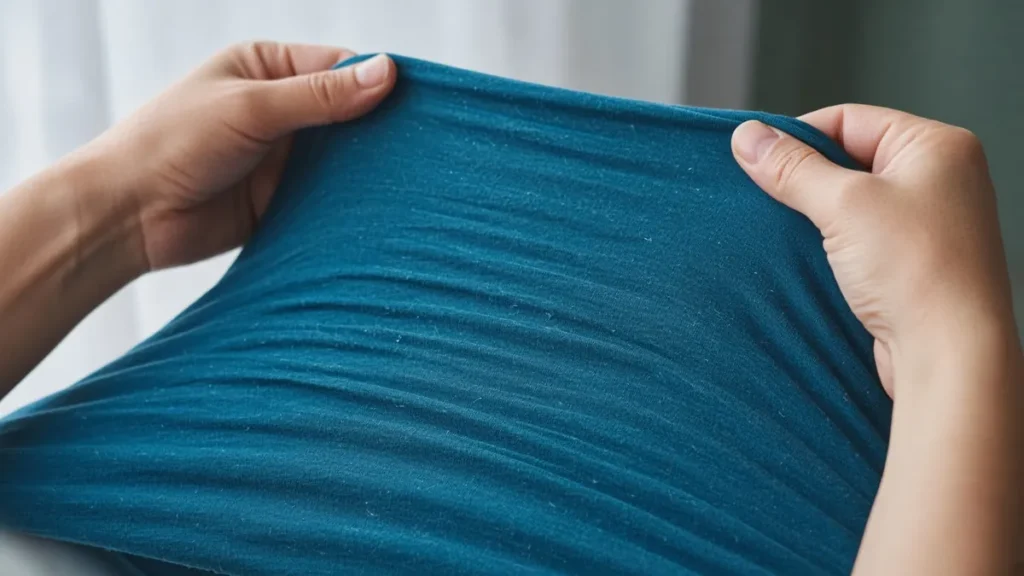
2-way stretch scrubs usually use fabric that gives across the body but not along its length. 4-way stretch scrubs stretch across the body and along it, so the fabric also gives when the wearer squats, kneels or reaches overhead. Choose 4-way for roles that move all shift and for close cuts such as joggers. Choose 2-way for teams that want a firmer, more tailored look.
For a brand or program buyer, the label is only a starting point. “2-way” and “4-way” describe the direction of stretch. How far a fabric stretches, how well it recovers and how much spandex it contains are separate properties that belong in your specification.
What 2-way and 4-way stretch mean
A 2-way stretch fabric gives in one direction and springs back. A common construction is a woven with stretch yarns only in its crosswise (filling) yarns. ASTM’s stretch test for wovens notes that fabrics built this way only need testing in that direction.
A 4-way stretch fabric gives crosswise and lengthwise. On scrubs, lengthwise stretch matters at the knee, seat and back because those areas are pulled along the body when someone bends or squats. Cuffed jogger scrubs rely on it more than straight legs do because the cuff holds the hem at the ankle.
Both terms are trade shorthand, and sellers use them loosely. Some call one-direction stretch “2-way”; others use “2-way” for fabric that stretches both ways. Ask every supplier to state the stretch in words: crosswise only, or crosswise and lengthwise.
Where the stretch comes from: spandex, yarn and knit
Spandex is the elastic fiber in polyester-spandex scrubs and in polyester-rayon-spandex blends. The FTC defines it as a manufactured fiber made from a synthetic polymer that is at least 85 percent segmented polyurethane. It can be stretched again and again and still recover to near its original length.
A knit is built from interlocking loops that open under tension, so it has some stretch even without spandex. Spandex in a knit helps it spring back after each pull. A woven’s yarns cross at right angles and hold each other in place, so a woven has little give unless it contains stretch yarns or is engineered for stretch.
Mechanical stretch is stretch built into the fabric without spandex. Cotton Incorporated, for example, has developed a way to give all-cotton wovens crosswise stretch through how they are woven and finished. If buyer and seller agree, ASTM’s woven method can also be applied to fabrics with similar stretch made without stretch yarns, so ask for stretch and recovery results to the same method you would use for a spandex blend. Our scrub fabrics comparison sets the main blends side by side.
2-way vs 4-way stretch at a glance
| Factor | 2-way stretch | 4-way stretch |
|---|---|---|
| Direction of stretch | One direction, usually crosswise | Crosswise and lengthwise |
| Common construction | Woven with stretch yarns in the filling only | Knit with spandex, or woven with stretch yarns both ways |
| Look and feel | Firmer and more structured | Softer in knits; wovens can still look tailored |
| Bending and squatting | Gives across the body only; the pattern needs room at seat and knee | Gives along the leg and back as well as across |
| Cuts it suits | Straight legs and classic cuts with more ease | Joggers, fitted tops and slimmer cuts |
| Seams to check | Seat and crotch seams in a squat | Every main seam and hem, stretched both ways |
| Test method to name | ASTM D3107 for wovens, in the stretch direction | ASTM D3107 for wovens or ASTM D2594/D2594M for low-power knits, in each stretch direction |
| Roles it often suits | Dental, lab, pharmacy and front-desk teams | Emergency, perioperative, EMS and therapy staff |
Which roles and ranges suit each
Start with how the wearer moves. Staff who kneel at bedsides, squat to low drawers, lift patients or work in vehicles load the knee and seat most, so lengthwise stretch helps them. Emergency, perioperative, EMS, physical therapy and pediatric teams often fit this group.
Dental, lab, pharmacy and front-desk staff spend more of the day at a counter or chair and often want a structured look. A firmer 2-way woven suits them. A poly-cotton scrub fabric with no spandex can also work if the pattern has enough ease for the job.
A brand can cover both needs with a structured core line and a stretch line for active roles. Keep each style in one fabric because the pattern is fitted to it and a fabric swap changes the fit customers reorder.
How to specify stretch and recovery
Put these points in the fabric specification before sampling:
- Construction and fiber. Woven or knit, fiber content by weight with spandex named, and fabric weight as set out in our guide to scrub fabric weight (GSM).
- Direction. Crosswise only, or crosswise and lengthwise, in words.
- Test method. ASTM D3107 measures stretch, growth and recovery of fabrics woven from stretch yarns. For low-power knits made for comfort rather than support, ASTM D2594/D2594M measures stretch and growth. Ask for results in each stretch direction, with the edition, lab and test date.
- Targets. Agree the values and tolerances before you approve the sample, based on the fabric you actually fitted.
- Bulk lot. Ask for results on the bulk fabric lot as well as the sample yardage.
Use the same lab for the sample and the bulk. ASTM does not recommend either method for acceptance testing of commercial shipments because precision between laboratories is poor. Use the figures to compare each lot with the approved one, and file them with the sealed sample.
How stretch changes fit, sizing and sewing
Stretch changes how much ease a pattern needs. A pattern fitted in a soft 4-way knit can pull at the seat when it is cut in a firmer 2-way woven, and a pattern made for a woven can look loose in a knit. Approve the fit and the fabric together, and fit again if the fabric changes.
Run the size-set fitting in the production fabric. A stretch fabric needs no separate size chart, but the chart should give the measurements of the garment made in that fabric.
Checks on a stretch sample
- Have wearers squat, kneel, reach overhead and climb a step, then check the seat, knee, crotch and back shoulder in each size.
- Ask which stitch types are used on the main seams. Then stretch the crotch, inseam, side seams and armholes by hand and look for popped stitches or seams that stay wavy.
- Pull the waistband and any jogger cuffs and check that they spring back.
- Test embroidery or prints on the stretch fabric itself because a logo on a stretch panel has to move with it.
- Wash the garment several times in the laundering it will really get, wear it for a shift, then look for bagging at the knee and seat.
Care and fiber labels for stretch blends
Fiber producers advise against chlorine bleach on spandex and recommend drying it on low heat. Compare that with how the garments will actually be laundered. Get the care limits for your blend from the mill and wash-test the sample under those conditions before you write the care label.
Under the FTC Care Labeling Rule, the manufacturer or importer needs a reasonable basis, such as test results, for the care instructions. On the fiber label, spandex is listed by its share of the fiber weight; FTC textile labeling guidance allows the ISO name elastane and lets spandex under 5% be named when it adds elasticity. Our guide to US scrub label requirements covers the other rules.
Stretch fabrics at GoMedWear
GoMedWear makes scrubs in its own factory in Sialkot, Pakistan, in polyester-rayon-spandex, polyester-spandex, poly-cotton, 100% cotton and polyester fabrics. On the private label route, you start from GoMedWear’s own developed styles, such as the stretch styles in the Performance Collection. The minimum is 50 pieces per style, and colors and sizes can be mixed within those 50. OEM styles are built to your tech pack, sketch or reference garment, and OEM minimums are quoted per project.
Every order starts with a sample, and free size-set samples let you fit and wash-test the fabric before you commit. Bulk production takes 15 to 25 days after you approve the sample. Each order goes through lab dips, sealed samples, inline checks at the machine, a full audit before packing and AQL inspection, and patterns and color runs stay on file so reorders match. To try the fabric on your own team, request a free size-set sample.
Frequently asked questions
Is 4-way stretch better than 2-way stretch for scrubs?
It depends on the role and the cut. 4-way stretch gives along the body as well as across it, so it suits active staff and close cuts such as joggers. 2-way stretch gives a firmer, more structured look for clinic, dental and lab teams that want a crisp uniform. Neither label shows how well a fabric recovers, so compare measured stretch and recovery on the actual fabric before choosing.
What are 4-way stretch scrubs?
4-way stretch scrubs are made from fabric that stretches and recovers both crosswise and lengthwise. The stretch usually comes from spandex blended into a knit or woven, as in polyester-spandex or polyester-rayon-spandex. The term only describes direction, so buyers should still ask for the fiber content and for stretch and recovery results to a named test method.
Do stretch scrubs need a different size chart?
They do not need a separate chart, but the chart must match the garment made in that fabric. Stretch changes how much ease a pattern needs, so the same size cut in a 4-way knit and in a firmer 2-way woven can fit differently. If one style comes in two fabrics, fit both in a size set and measure the finished garments before you publish or issue a chart.
Can scrubs stretch without spandex?
Yes, to a degree. Knits give through their loop structure, and some wovens get mechanical stretch from the way they are woven and finished. Spandex is added when a fabric needs elastic stretch and recovery. If a supplier offers stretch without spandex, ask for stretch and recovery results to the same test method you would use for a spandex blend.