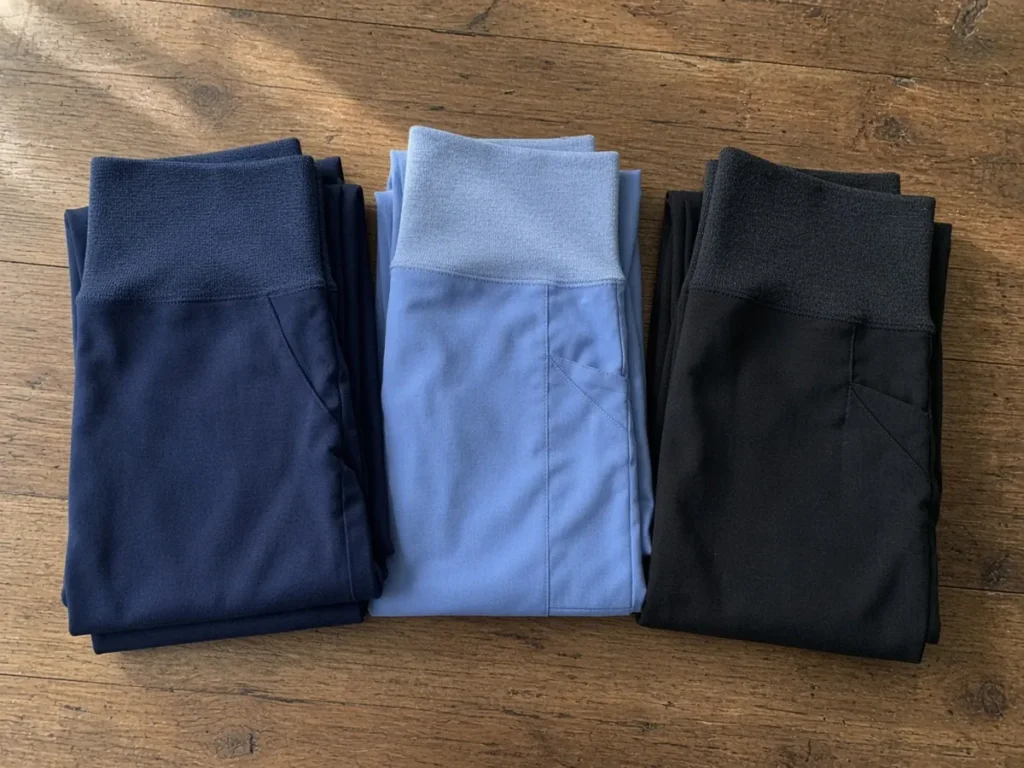
Brands size maternity scrubs in one of two broad ways. Some label them by the wearer’s usual size and build room for the bump into the pattern. Others size them from measurements taken during pregnancy, so the label can differ from the size the wearer normally buys. Each brand picks its own method and stretch varies by style, so retail advice runs from “size down” through “order your usual size” to “size up”.
So a scrub brand or private label buyer should choose one rule, build the chart and pattern around it, and print it wherever someone picks a size. A hospital, clinic group or school should fit each person on a size set of the exact style, stock maternity versions of its role colors and keep a small reserve so nobody waits for a production run.
How maternity scrubs are sized
The two rules differ in what the label refers to. Under a usual-size rule, a maternity medium fits someone who wears a medium in your regular scrubs. Under a measurement rule, each size is defined by bust, belly and hip measurements taken during pregnancy.
| Question | Labeled by usual size | Labeled by pregnancy measurements |
|---|---|---|
| How the wearer chooses | Orders her size in your regular scrubs | Measures bust, belly and hips, then reads the chart |
| What the pattern does | Adds room at the belly, bust and hips to each regular size | Grades each size to pregnant body measurements |
| Works best when | Customers already know your regular fit | Wearers are new to the brand or fitted in person |
| Main risk | Bust or hips change more than the pattern allows | The right size may change later in the pregnancy |
| What to print | “Order your usual size” plus one exception line | The chart, how to measure and when to measure again |
Either rule works if the same words appear on the size chart, product page, hang tag and order form. Test it on every style, because a full panel over the bump and a lower band under it fit differently (see the panel types on our maternity scrubs page). For a new brand, settle the rule before the first sample, alongside the range decisions in our guide to starting a scrub brand step by step.
What a maternity size chart needs that a regular chart does not
A regular chart, such as our scrub size chart for men and women, works from bust or chest, waist and hip. A maternity chart should start from a pregnant-body baseline. One is ASTM D7197/D7197M-21, the Standard Table of Body Measurements for Misses Maternity Sizes Two to Twenty-Two. This active standard says its body measurements can guide apparel design once fabric, ease, styling and fit are considered.
ASTM sells the standard, so buy it or have your pattern maker work from it. It covers misses sizes 2 to 22, so plus-size maternity scrubs above that range need their own grading decisions. A range labeled XS to 5XL also needs an agreed match between letters and numeric sizes.
| Measurement to add | Why it matters | How to record it |
|---|---|---|
| Belly at the fullest point | Sets panel width and how far the panel must stretch | Tape level around the fullest part of the bump; note the stage of pregnancy |
| Bust | A top that fits over the belly can still pull across the bust | Tape level around the fullest part of the bust |
| Under-bust | Places any seam, tie or shaping above the bump | Tape level directly under the bust |
| Hip at the fullest point | Pants must pass over the hips with the panel up | Tape level around the widest part of the hips and seat |
| Front length over the bump | The bump takes up length, so tops need more at the front than the back | High point of the shoulder over the bump to the hip line, then the same at the back |
| Usual size in your regular range | Ties the chart to your sizing rule | Ask the wearer, or use the program’s size records |
Add the maternity points to the garment spec as well: panel height, panel width relaxed and stretched, and the extra front length on tops. Give each a tolerance and measure it on every size in the size set. Under a usual-size rule, these points go into the pattern and spec while customers keep using your regular chart.
What to check on a maternity sample
Fit the sample on wearers at different stages of pregnancy if you can, with the panel in its designed position, and check:
- Panel coverage: it stays in place when the wearer bends, squats, reaches overhead and sits.
- Panel recovery: it returns to shape after stretching, both new and after several washes in the intended laundry process.
- Panel seam: it lies flat and does not show as a ridge under the top.
- Front hem: the top hangs level front to back instead of riding up over the bump.
- Bust: no pulling at the neckline or side seams.
- Pockets: easy to reach with the panel up, and a loaded pocket does not drag the waist down.
- Color: belly panels are often a rib or stretch knit, so approve the panel against the same color standard as the main fabric.
- Labels: the size label marks the piece as maternity so it never mixes with regular stock.
Keep the approved sample. Check every reorder against it and the measured spec.
Supplying maternity scrubs to staff
For employers, maternity scrubs are an HR policy question as well as a buying one. The Pregnant Workers Fairness Act covers private employers and state and local governments with 15 or more employees, plus Congress and federal agencies. It took effect on June 27, 2023, and the EEOC’s regulation on June 18, 2024. In its guidance on the Pregnant Workers Fairness Act, the EEOC lists “changing a uniform or dress code or providing safety equipment that fits” as one example of a reasonable accommodation.
The EEOC expects employer and employee to discuss each request, whether by talking or by email. It calls this the interactive process. It also notes that in many cases supporting documentation is not needed. This guide is not legal advice, so set your policy with HR or employment counsel, then put the practical points in writing:
- Requests: one named contact, such as the uniform coordinator, and a short form that asks only for style, size and role color. A request to a manager or HR still counts, so route those to the same contact.
- Colors: maternity versions of every role color in your hospital uniform program, so patients and colleagues can still tell each person’s role at a glance.
- Sets: whether maternity sets replace some of each person’s regular sets or come on top of them (see our guide to working out sets per person, reserves and reorders).
- Fitting: a maternity size set in the uniform room and a second fitting if the first size stops fitting, using the same method as running fit sessions with a size set.
- Afterwards: whether sets are returned for laundering and reissue or kept by the wearer.
Planning maternity stock: pieces, sizes and reorders
Each wearer needs maternity scrubs for a limited time, so demand is harder to forecast than for core styles. Keep the range narrow, with one or two tops and one pant in your best-selling or role colors.
Plan the size split from your own records. With a usual-size rule, your regular women’s split is a sensible start. With a measurement rule, use fit sessions or first-season sales, then adjust.
Small, mixed quantities only work if sizes and colors can be mixed inside a style’s minimum, so ask before you plan. Check too that the panel knit is dyed to each color you order.
A staff program should hold a small reserve in the common sizes and each role color. A new run needs a sample, production and shipping, which is too long for someone who needs scrubs that fit now. Log every request to see which sizes and colors to refill. Reorder on the approved pattern, panel spec and color standard so new sets match both the first order and the regular uniform.
Maternity scrubs at GoMedWear
GoMedWear makes scrubs in its own factory in Sialkot, Pakistan, for scrub brands, distributors, hospitals, clinic groups and schools. See our maternity scrub pants page for the current maternity range.
- Private label scrub manufacturing: our own developed styles under your brand, from 50 pieces per style, with sizes and colors mixed inside those 50.
- OEM production: your own maternity design, such as a nursing-access top, built to your tech pack, sketch or reference garment, with minimums quoted per project.
- Sizes XS to 5XL from computer-graded patterns, depending on the style, in 30+ stock colors or a Pantone match approved by lab dip.
- Free size-set samples, then bulk production 15 to 25 days after you approve the sample.
- Sealed samples, inline checks, a full audit before packing and AQL inspection, with patterns and color runs kept on file for reorders.
- Woven labels, care labels and hang tags made in-house.
To begin, request a free size-set sample and fit it on your team or test wearers.
Frequently asked questions
Do you size up in maternity scrubs?
It depends on the brand’s sizing rule. Some maternity scrubs are cut so the wearer orders her usual size, with room for the bump built in. Others are sized from pregnancy measurements, so the label may be larger than her regular size. Brands should print their rule, and employers should fit staff on a size set of the exact style.
What measurements does a maternity size chart need?
Start from a pregnant-body baseline such as ASTM D7197/D7197M-21, which covers misses maternity sizes 2 to 22. Add belly at the fullest point, bust, under-bust, hip and front length over the bump, plus the wearer’s usual size in your regular range.
Do employers have to provide maternity scrubs?
The EEOC lists changing a uniform or dress code as one example of a reasonable accommodation under the Pregnant Workers Fairness Act, which covers employers with 15 or more employees. Whether a specific request must be met depends on the worker’s known limitation and whether the change would cause undue hardship, which the EEOC defines as significant difficulty or expense. Set your policy with HR or employment counsel. This guide is not legal advice.
When do staff usually switch to maternity scrubs?
There is no fixed point. It depends on the person, the style and how the regular uniform fits. Let staff request maternity scrubs at any stage through one named contact, and keep a reserve in the common sizes and role colors so garments are on hand when someone asks.