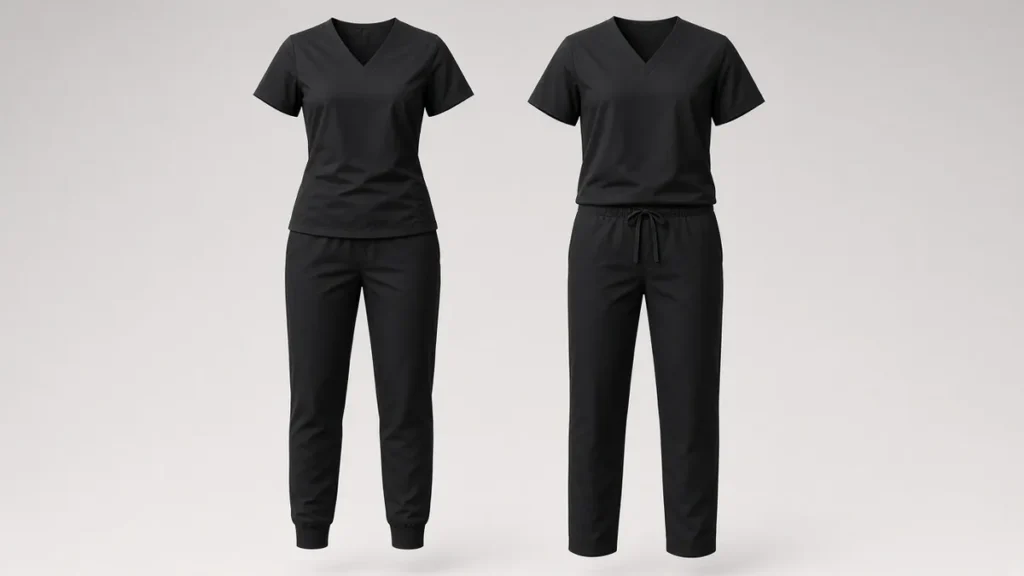
Jogger vs straight-leg scrubs comes down to the hem. Jogger scrub pants taper from the thigh to a ribbed or elastic cuff at the ankle, while straight-leg pants hang at the same width from the knee to an open hem. For a range or a uniform program, the right choice depends on who will wear them. Joggers suit staff who want a close, athletic fit and a hem that stays off the floor. Straight legs suit a wide mix of bodies and fabrics, and they are the traditional choice where dress codes are strict.
Leg style also affects the fabric you can use, how you plan inseams, which waistband works and whether a clinical site will accept the pant. This guide compares jogger, straight, wide and flare legs for buyers and gives you sample checks for each style.
Jogger vs straight-leg scrubs, plus wide and flare legs
Use the table below to plan a range. Each row covers how the style is built and what you need to plan for it.
| Style | Leg shape | Hem | Who it suits | Fabric needs | Length planning | Dress-code fit |
|---|---|---|---|---|---|---|
| Jogger | Room in the seat, tapers from thigh to ankle | Rib-knit or elastic cuff | Staff who are on their feet and moving, and fashion-led customers | Stretch with good recovery, so the cuff and knees spring back | The cuff absorbs some extra length, so fewer length options are needed | Widely worn, but some programs and placement sites ask for a traditional pant |
| Straight | Even width from knee to hem | Open, sometimes with side vents | The broadest workforce, and wearers who want a roomier, classic look | Works in stretch blends and in poly-cotton or cotton | The open hem shows every inch, so offer short, regular and long | The traditional choice; still check hem and fabric rules |
| Wide | Full from hip or thigh down | Open and wide | Wearers who want a relaxed drape and more air around the leg | A fluid fabric that drapes; stiff fabric looks boxy | Hem length matters most, so length options are needed | Usually accepted, but check hem rules for clinical areas |
| Flare | Fitted through hip and thigh, widens below the knee | Open and flared | Brands selling a yoga-pant look | Stretch and recovery to hold the fitted upper leg | The point where the flare starts and the hem length both need length options | Reads as a fashion style, so confirm before issuing it |
For product detail on each cut, see our pages on jogger scrubs, wide-leg scrub pants and flare scrub pants.
What each style needs from the pattern and fabric
Joggers
A jogger pattern has to balance taper and movement. If the taper starts too high, the thigh feels tight when the wearer squats or kneels. The cuff needs enough tension to stay in place without marking the skin, and it needs to stretch enough to push up the calf. Use a stretch fabric with good recovery, because a cuffed pant shows knee bagging quickly. Our guide to 2-way and 4-way stretch fabric explains how the stretch direction affects this.
Straight legs
Straight legs are the simplest pattern to grade across a wide size range, and they forgive small fit differences. They work in poly-cotton and 100% cotton as well as in stretch blends.
Wide and flare legs
Both styles depend on drape. Wide legs need a fabric that falls cleanly. Flares need stretch through the upper leg and a flare point that stays at the knee as sizes grade up and down. If the grading moves that point too far, larger and smaller sizes will look like different styles.
How the hem drives inseam planning
A cuff gathers a little extra length, so one jogger inseam covers more heights than one straight inseam does. Open hems on straight, wide and flare pants show the true length. These styles need short and long options if you want them to fit the whole workforce. Check the inseams on offer for each style against the tall scrub options before you finalize a size plan.
Waistbands and pockets by style
Waistband and pocket choices should follow the leg style, because they change how the pant hangs.
- Joggers: usually paired with a knit or yoga waistband, or an elastic back with a drawstring. Cargo pockets sit higher on the thigh because the leg narrows, so check that a loaded pocket does not pull the leg out of line.
- Straight legs: the most flexible. A drawstring with elastic suits programs with many body types, and a flat front with elastic at the back suits a smarter look. Side cargo pockets have the most room on this cut.
- Wide legs: heavy cargo pockets can spoil the drape. Slash pockets at the hip and one smaller cargo pocket keep the line clean.
- Flares: a wide yoga waistband matches the fitted upper leg. Keep pockets flat, or the fitted thigh will show the bulk.
Whatever you choose, keep the same pocket layout across sizes so staff can find their tools by feel.
Dress codes and school clinicals
Whether jogger scrubs are allowed depends on the employer or placement site, and dress codes vary a lot. Some hospitals and clinics accept joggers and other modern cuts. Others, and some clinical placement sites used by nursing and allied health schools, ask for a traditional straight pant. Find out what the rules are before you choose styles, so you do not have to replace pants after rollout.
- Ask each department or placement site for its written dress code. Do not rely on what staff have heard.
- Check what the code says about hem length, fit and fabric, as well as color.
- Where sites disagree, issue a style that every site accepts. In practice, check whether a straight leg meets all of them.
- Write the approved pant styles into the program handbook or student uniform list.
Choosing pant styles for a range or uniform program
For a scrub brand or retailer
A focused launch usually starts with one jogger and one straight leg, both in the same fabric and colors so tops pair with either. Add a wide or flare style once you know which customers you are reaching. Our guide on launching a scrub brand with a small range covers why fewer styles make reorders easier. You can see how a jogger line is built across colors in the performance jogger collection.
For a hospital, clinic group or school
Programs work best with one or two pant styles. A common setup is one straight leg as the standard pant, plus a jogger as an option where the dress code allows it. Plan a size split for each style, because the same person may wear a different size in a fitted jogger than in a straight leg. The steps for choosing styles and sizes across a workforce are in our guide to setting up a scrub uniform program.
Sample checks for each leg style
Have wearers try each sample at work, not just in front of a mirror. Ask them to squat, kneel, climb stairs and reach, and then check the points below.
- Jogger cuff tension: the cuff stays at the ankle when walking, pushes up the calf without strain and leaves no deep mark after a shift.
- Jogger taper: no pulling across the thigh or knee when squatting, and the seat does not drop when bending.
- Straight hem length: the hem clears the floor in work shoes and does not ride up above the ankle when sitting.
- Wide-leg hem: the hem does not catch under the heel, and the drape stays clean after washing.
- Flare break point: the flare starts at the knee on the smallest and largest sizes as well as the sample size.
- Rise: the waistband stays in place when bending, on both mid-rise and high-rise versions.
- After washing: wash the sample several times and check the cuff recovery, knee bagging and hem shrinkage again.
Scrub pants at GoMedWear
GoMedWear makes scrub sets, tops, pants and joggers in its own factory in Sialkot, Pakistan, for scrub brands, distributors, hospitals, clinic groups and schools. Its wholesale scrub pant range can be produced under your label with a minimum of 50 pieces per style, with colors and sizes mixed within those 50 pieces. OEM pants are built to your tech pack or reference garment, with minimums quoted per project. Sizes run from XS to 5XL, depending on the style. Fabrics include polyester-rayon-spandex, polyester-spandex, poly-cotton and 100% cotton, in 30+ stock colors or a Pantone match.
Every order starts with a sample, and bulk production takes 15 to 25 days after you approve it. Patterns and color runs are kept on file, so reorders of each leg style match the first run. You can compare cuts for women’s lines on our women’s scrub pants page, then request a free size-set sample of the styles you are considering.
Frequently asked questions
Are jogger or straight-leg scrubs better?
Neither is better for every wearer. Joggers taper to a cuff, keep the hem off the floor and give a close, athletic fit. Straight legs fit a wider range of bodies, work in more fabrics and are the style dress codes most often expect. A brand range can carry both. Uniform programs often issue a straight leg as the standard and add joggers as an option where the dress code allows them.
Are jogger scrubs allowed in hospitals and school clinicals?
It depends on the employer and the placement site. Some hospitals and clinics accept joggers, while other employers and clinical sites ask for a traditional straight pant. Before choosing styles, get the written dress code from each department or site. If the sites disagree, issue a style that all of them accept. Then list the approved pant styles in the handbook or student uniform list.
How are jogger scrubs supposed to fit?
On a well-fitted jogger, the cuff lands on the ankle bone or slightly higher and leaves no deep mark after a shift. The seat and thigh have enough ease that the wearer can kneel without the knee pulling. A leg that is too long gathers above the cuff, and a leg that is too short lets the cuff ride up the calf. Check both on the sample.
What is the difference between wide-leg and flare scrub pants?
Wide-leg pants are full from the hip or thigh down to an open hem, so they need a fabric that drapes well. Flare pants are fitted through the hip and thigh and widen below the knee. They need stretch and recovery to hold the fitted upper leg. Both styles have open hems, so plan short and long length options for either one.