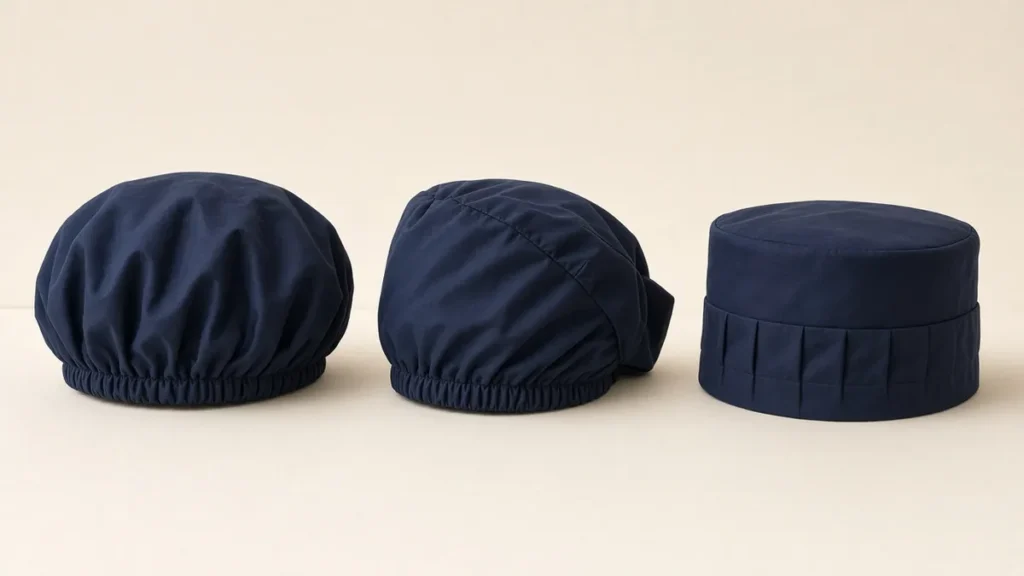
The main types of scrub caps are the skull (tie-back) cap, the euro cap, the pixie cap, the bouffant cap and the ponytail cap. They differ in three ways that matter to a buyer: how much room the crown has, how the cap closes at the back, and how much hair it can hold. A skull cap sits close to the head and ties at the nape. A bouffant cap is a loose crown gathered by elastic, and a ponytail cap adds a pouch or opening for long hair.
For a brand, distributor or hospital, the choice comes down to the hair your wearers have, the setting they work in and where your logo or name has to go. Style names change from brand to brand, so specify shape and closure in writing instead of relying on a label like “poppy” or “surgeon cap”.
The main scrub cap styles side by side
This table describes each style by construction, which is how a factory reads an order.
| Style | Shape | Usual closure | Hair it suits | Typical setting | Logo or name area |
|---|---|---|---|---|---|
| Skull (tie-back) | Close-fitting crown with a front band | Ties at the nape | Short hair, shaved heads, small low buns | Operating room, anesthesia, men’s ranges | Front band or front panel |
| Euro | Rounded crown sewn to a wide band | Elastic back, sometimes a cord and toggle | Short to medium hair | Operating room, procedure rooms, veterinary | Front of the band |
| Pixie | Shallow, snug crown | Elastic back, sometimes with ties | Short or fine hair, chin-length cuts | Clinics, dental, wards | Small area on the front |
| Bouffant | Full, roomy crown gathered all round | Elastic casing, sometimes a cord lock | Thick, curly or long hair worn up | Wards, clinics, OR where policy allows | Side or front of the crown, or all-over print |
| Ponytail | Fitted front with a back opening or pouch | Elastic plus ties or a toggle | Long hair in a ponytail or braid | Operating room, wards, clinics | Front panel |
Each style in brief:
- The tie-back skull cap is the classic surgeon’s cap.
- The euro cap with its wide band sits between a skull cap and a bouffant.
- The low-profile pixie cap is a shallow fitted shape.
- The full-crown bouffant style holds the most hair.
- The ponytail cap with a back pouch is built for long hair worn down the back.
Scrub cap, surgical cap or scrub hat: what the names mean
In everyday use, “scrub cap”, “scrub hat” and “surgical cap” often name the same head cover, though “surgical cap” is also used for disposable caps. The difference that matters is the claim attached to the product. US federal rule 21 CFR 878.4040 treats surgical apparel, with surgical caps as an example, as a medical device when it is intended to protect the patient and OR staff from transfer of microorganisms, body fluids and particulate material.
The practical point for brands: describe a fabric cap by its style, fabric and fit. Avoid barrier or protection wording on hang tags, listings and catalog copy unless you have taken regulatory advice. Our surgical scrub caps page shows the reusable OR-style caps we make.
Closures and fit: ties, toggles and elastic
Closure decides whether one cap fits many heads and how fast it goes on.
- Ties. Two fabric ties knotted at the nape. The most adjustable option, so one size can cover a wide range of heads. Slower to put on, and long ties can tangle in the wash.
- Toggle or cord lock. A drawcord through a channel, held by a spring toggle. Quick to adjust with one hand and easy to loosen during a long shift. Check that the toggle is secure and has no sharp edges.
- Elastic. An elastic casing or back panel. Fastest on and off, but the fit range is fixed by the elastic, so these caps are often made in more than one size.
Many caps combine two systems, such as an elastic back with ties. Decide early whether each style is adjustable one-size or sized, since sized caps add stock-keeping units.
Matching styles to hair length and volume
Hair volume drives comfort. Too tight and hair escapes at the edges; too loose and the cap slips.
- Short or fine hair: skull, pixie or euro caps.
- Medium hair worn up: euro or a smaller bouffant.
- Thick, curly or textured hair, or high buns: bouffant, or a ponytail cap with a deep pouch.
- Long hair in a ponytail or braid: ponytail cap.
- Staff who wear a hijab: head covers designed to go under or replace a standard cap. See our guide to hijab options for surgical staff.
Surgical headwear also changes the choice. AORN notes that magnifying loupes and headlights can affect the type of head cover selected. If your wearers use them, include loupes or headlights in the fit check and ask whether a low crown and a closure that stays put under a headband suit them better.
Fabric, lining and small details
Most reusable caps use a light woven cotton, poly-cotton or polyester fabric, and stretch blends are used for fitted styles. Solid colors usually match the scrub set, and prints let a brand give its caps a look of their own. A satin-lined cap adds a smoother inner layer under the outer fabric. Describe it as a smoother lining, without hair-health claims.
Details to specify on any cap:
- A sweatband or absorbent front band, and what it is made of.
- A button or tab at the side or back for mask loops.
- Seam finish inside the crown, so no raw edges touch the scalp.
- Tie length and finish, or toggle type and cord color.
- The logo or name position, and the method (embroidery, print or sublimation).
Under FTC rules, caps fall outside the Textile Act and the Care Labeling Rule unless they contain wool, which brings in the Wool Rules. Many brands still add fiber and care labels, so confirm your approach with a compliance adviser and see our scrub label requirements guide.
Caps for the operating room
For restricted and semi-restricted areas, AORN’s surgical attire guideline says to cover the scalp and hair, and notes that correctly sized head covers help contain hair. In separate AORN guidance for perioperative staff, AORN states that the facility decides which types of head coverings can be worn and whether reusable ones are allowed. If reusable caps are allowed, the facility should set how often they are laundered and by which method.
Some facilities require disposable caps in the OR, and others allow reusable fabric caps under a laundering process. If you supply hospitals, ask each account for its written attire policy and match styles to it.
Planning a cap range or a team order
A retail range needs coverage across hair types. A team order needs caps that meet the facility’s policy.
For brands and distributors
- Cover the main hair needs: one fitted style (skull or pixie), one mid style (euro) and one full style (bouffant or ponytail).
- Write a one-line definition of each style in your listings, because shoppers see different names on other sites.
- Choose colors to match your scrub line, then add prints for the styles that sell on design.
- Decide which styles are one-size adjustable and which are sized.
For hospitals, clinics and schools
- Get the written attire policy for each area before choosing styles.
- Offer at least two styles so staff with long or thick hair have a fit that works.
- Agree how names, roles or department colors will appear, and keep the logo area small on fitted caps.
- Run a fit check with a sample set on several wearers, including staff who wear loupes or headlights.
- Confirm the laundering process the caps will go through, and test a sample through it before the bulk order.
For bulk buying by style and color, see our wholesale scrub cap options.
Scrub caps at GoMedWear
GoMedWear makes reusable scrub caps in its own factory in Sialkot, Pakistan, for scrub brands, uniform distributors, hospitals, clinic groups and schools. Private label orders start at 50 pieces per style, with colors and sizes mixed inside those 50 pieces. OEM caps are built to your tech pack, sketch or reference cap, with minimums quoted per project. You can pick from 30+ stock colors or a Pantone match, and add embroidery, DTG printing, screen printing or sublimation done in-house. See custom scrub caps with your logo for options.
Every order starts with a sample, and bulk production takes 15 to 25 days after you approve it. Quality steps include lab dips, sealed samples, inline checks and AQL inspection, and patterns and color runs stay on file so reorders match. We ship DDP door-to-door, including to the United States and Canada, or FOB Karachi if you use your own forwarder. To compare styles on real heads first, request a free sample set.
Frequently asked questions
What are the main types of scrub caps?
The main types are the skull or tie-back cap, the euro cap, the pixie cap, the bouffant cap and the ponytail cap. Skull and pixie caps fit close to the head, the euro cap has a wide band and a slightly fuller crown, the bouffant has a roomy crown gathered with elastic, and the ponytail cap adds a back opening or pouch for long hair.
What is the difference between a scrub cap and a surgical cap?
In everyday use the names often overlap, though “surgical cap” also covers disposable caps. The difference is in the claim. Under 21 CFR 878.4040, surgical caps intended to protect patients and OR staff from transfer of microorganisms, body fluids and particulate material are regulated as medical devices. Brands selling reusable fabric caps should describe style, fabric and fit and avoid protection wording unless they have regulatory advice.
Which scrub cap style is best for long or thick hair?
A bouffant cap suits thick, curly or long hair worn up in a bun, because the crown is full and gathered with elastic. A ponytail cap suits long hair worn down the back, with an opening or pouch behind. For a team, offer both alongside a fitted style and run a fit check with sample caps before ordering in bulk.
What is the difference between a bouffant and a ponytail scrub cap?
A bouffant cap has a full, roomy crown gathered all round with elastic, so it holds hair pinned up in a bun or worn thick and curly. A ponytail cap has a fitted front and an opening or pouch at the back, so long hair can hang in a ponytail or braid. Many teams stock both so staff can choose by how they wear their hair.